
Missouri Arrest Log Layers
An arrest log is a format, not one standard record. Each Missouri source fills it differently. A sheriff may post selected incidents in a press archive, while a jail vendor can retain several days of booking detail. MSHP takes a wider path, offering a person-level arrest report with a five-day online window plus a separate dated news-release archive. A newsroom may cover one case and skip many arrests entirely. Every source carries its own scope and date labels.
The multi-day view helps. Weekend arrests often surface in a later batch. Dates can still mislead. A publication date is not always the date of the arrest. Keep the source name, the date shown, and the agency named in the entry together, since a blotter can leave cases out, combine incidents, or list only selected events, and no blotter is a complete statewide record.
One line can carry an arrest date, a booking date, a posted date, a charge, and a status. Read each label as written. A field that says “arrested” does not mean the person was still in custody when the item appeared. Ask the source agency. It can confirm which event the entry describes.
Where Missouri County Logs Appear
County sources vary more than their labels promise. Some keep an official current roster but no archive. Others hold dated press releases instead. Regional systems can show older booking detail even when their home screen stresses current custody. The directory routes to each county and St. Louis City, where the local agency's own page decides what can be searched.
| Official source | Typical span | What to verify |
|---|---|---|
| County sheriff press page, such as Barry County’s archive | Dated posts, sometimes older than the live roster | Post date and event date may differ |
| County or regional jail portal | Current record or limited booking history | Archive depth and photo display depend on the interface |
| MSHP Online Arrest Reports | Five-day Patrol arrest-report window | Preliminary, unofficial, and limited to MSHP arrests |
| MSHP News Releases | Dated narrative archive | Selective enforcement and arrest announcements |
| Sunshine request | Requested date range, subject to retention and closure rules | Ask for a named record series and custodian |
Start at the Missouri County Directory. Then open the linked roster. A records contact listed by that locality handles older arrest records the public page does not show.
MSHP Arrest Reports and News
MSHP's Online Arrest Reports page is the only statewide person-level arrest search in Missouri. It covers Patrol arrests, though, not every agency. Entries post automatically and carry a preliminary, unofficial warning. After five days, they leave the public page. That window is not an archive of earlier Patrol work. For dated narrative releases, the News Releases index reaches back further but sticks to selected topics.
Annual and program reports add context. The Patrol's 2024 and 2025 summaries cover enforcement work, targeted DWI projects, citations, and arrests. They describe a program and a year. Troop pages and traffic reports have their own purpose. None of them is a complete arrest blotter, and none replaces a person-level report.
The MSHP Online Arrest Reports search states its preliminary status and five-day display limit.
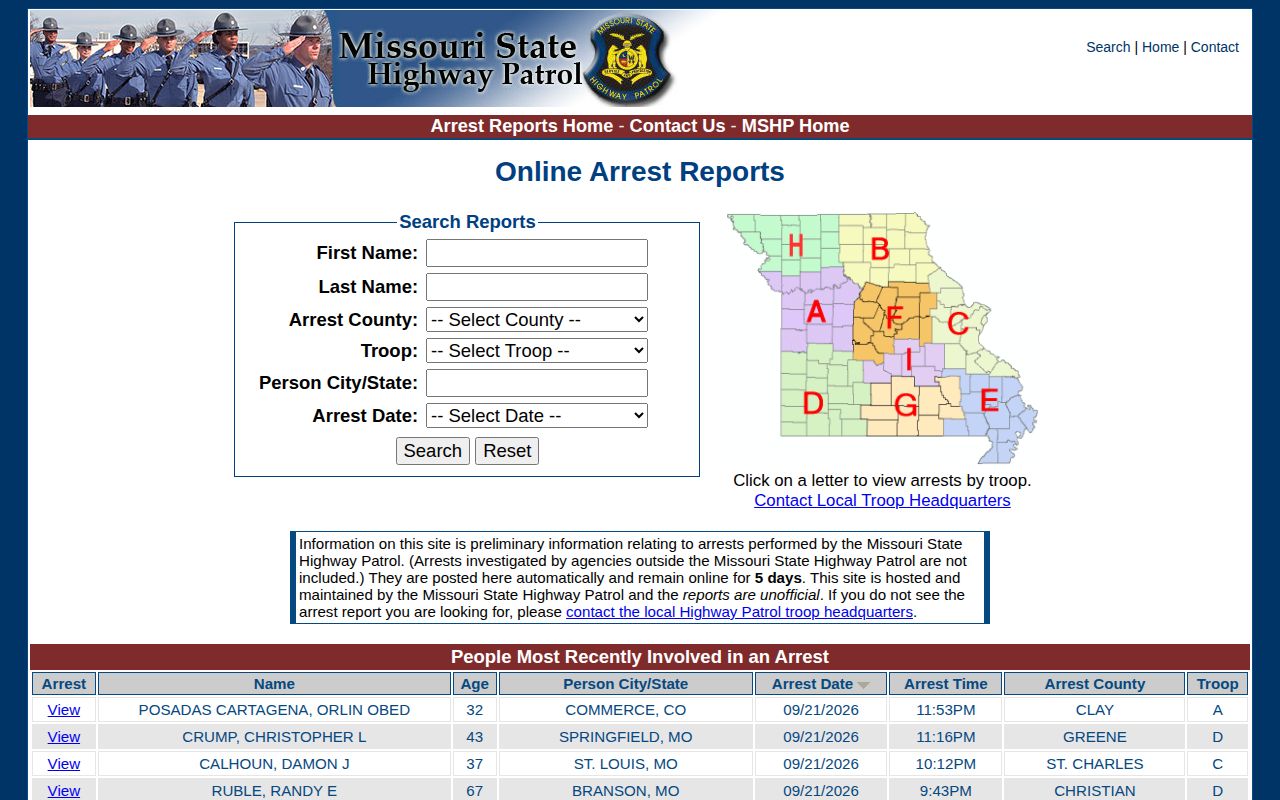
The HP71 window is not a permanent archive. For an older Patrol report or a request by troop and date, use the Public Records Center.
Five-Day Patrol Arrest Window
The five-day rule is narrower than it sounds. It sets how long the Online Arrest Reports page keeps person-level entries. Nor does it fix the agency's retention period. It also skips arrests made by county sheriffs and city police. The News Releases index is a separate narrative archive, so it can preserve an announcement after an HP71 entry drops.
That helps once a search passes the public window. Still, it will not hold every Patrol arrest. Request the report from the Patrol with the date, county, troop, and any report details you have. For another agency, ask its records custodian. A searchable page and a retained official record are two different things.
Read a Missouri Arrest Log Entry
Note what each field refers to first. Short summaries have limits. One can omit the custody location, a later transfer, or the final court result. A report number or the arresting agency leads to the full report from that office.
| Field | Meaning and limit |
|---|---|
| Name or age | Identity details as published; compare more than one field |
| Arrest date | Event date if clearly labeled; may differ from post date |
| Agency, county, or troop | Where to seek the original report; not always the jail location |
| Charge | Charge recorded by police, subject to court change |
| Booking or custody status | Processing or current hold as shown at that source’s last update |
| Photo | Image supplied under that publisher’s policy |
- Check the publisher and whether it is an agency, court, or newsroom.
- Separate the date of the event from the date the item was posted.
- Identify the arresting agency and ask it for the underlying report if context is missing.
- Check the public court docket for later events; a charge in a log is not a disposition.
A booking photo may appear, depending on the source's display choice. Don't copy one into a separate gallery or treat it as the outcome of a case.
News Blotters and Third-Party Logs
News outlets give an editorial record, not a booking database. Treat them as context for Missouri arrests, not as a comprehensive blotter. KSHB 41 Kansas City has a published policy limiting police mugshot use. It also offers an appeal path for a photo already posted. First Alert 4/KMOV, KSDK 5 On Your Side, and the Missouri Independent each list a contact route for corrections or case updates. None of the three promises general removal. No outlet here runs a full arrest roster.
Private indexes republish arrest data too. BustedNewspaper, RecentlyBooked, Mugshots.com, Arrests.org, and county-level Mugshots.zone pages all fit that mold. Their entries can be stale or incomplete. So they are not official Missouri arrest logs. Never rely on them for a warrant, charge, or custody status. If you request a correction, include the exact URL plus an official case result.
The MSHP News Releases archive is an official dated source for selected Patrol arrests and enforcement news.
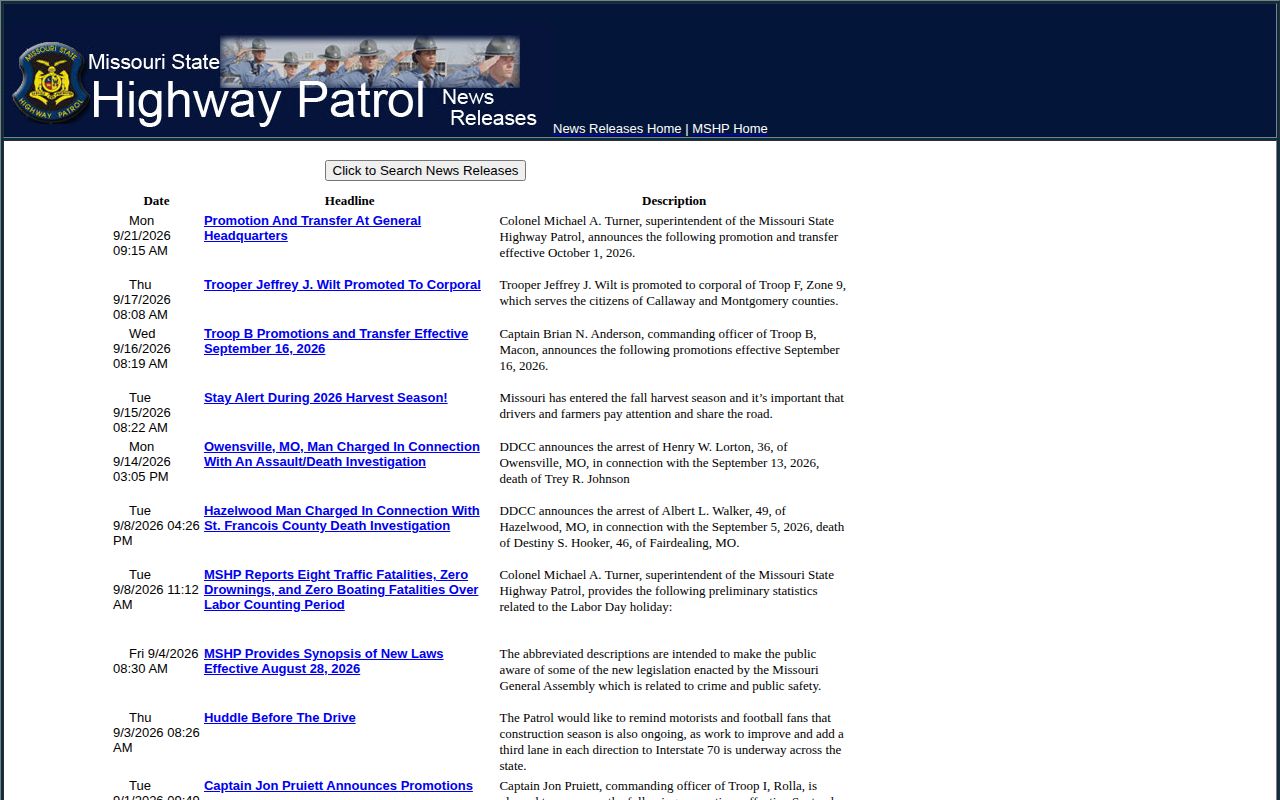
News stories add agency context, yet remain selective coverage.
Weekend Arrest Log Delays
Weekends slow Missouri arrest logs down. Offices often publish in batches after a holiday. A current roster may refresh through the week, while a press archive grows only when staff prepare a release. A Monday post can cover several days of arrests. State law sets no fixed lag for every jail, sheriff, police department, or newsroom in Missouri.
An entry can carry two dates. Match the event date to the arrest, and use the publication date to see when the source became public. With one date only, call it the date the publisher shows. The Daily Arrest Report page explains same-day source windows.
Older Logs and Official Archives
Web archives expire on different schedules. MSHP keeps person-level arrest reports online for five days. A county roster may show present custody only. A sheriff's press page can keep dated items far longer. Retention rules sit on a different shelf. The Missouri Secretary of State's sheriff retention schedule places arrest records, arrest logs, arrest files, arrest registers, and booking sheets under SHF 006 with a five-year minimum. That is an agency retention rule, nothing more. It does not promise the public page stays searchable for five years.
The same schedule splits jail activity logs and inmate files into separate series. Fingerprints, photos, and other biometrics normally go to the MSHP Central Repository. The sheriff may keep a reference copy. A retained record can outlast its web listing. Closure, redaction, or access limits may still apply, so ask for the record series and date range rather than assuming the old roster is still available.
Once a record passes the web window, send a focused Sunshine request to the agency that created the arrest report. Missouri's law generally calls for a prompt response. Reasonable search and copy costs are permitted. When an agency no longer holds the item, the Secretary of State's records and archives resources can point to retention or archival paths. Arrest logs and rosters are different landscapes. Blend them into one list and you lose track of both.
The Missouri State Archives RG114 page describes historical corrections images and its research path.
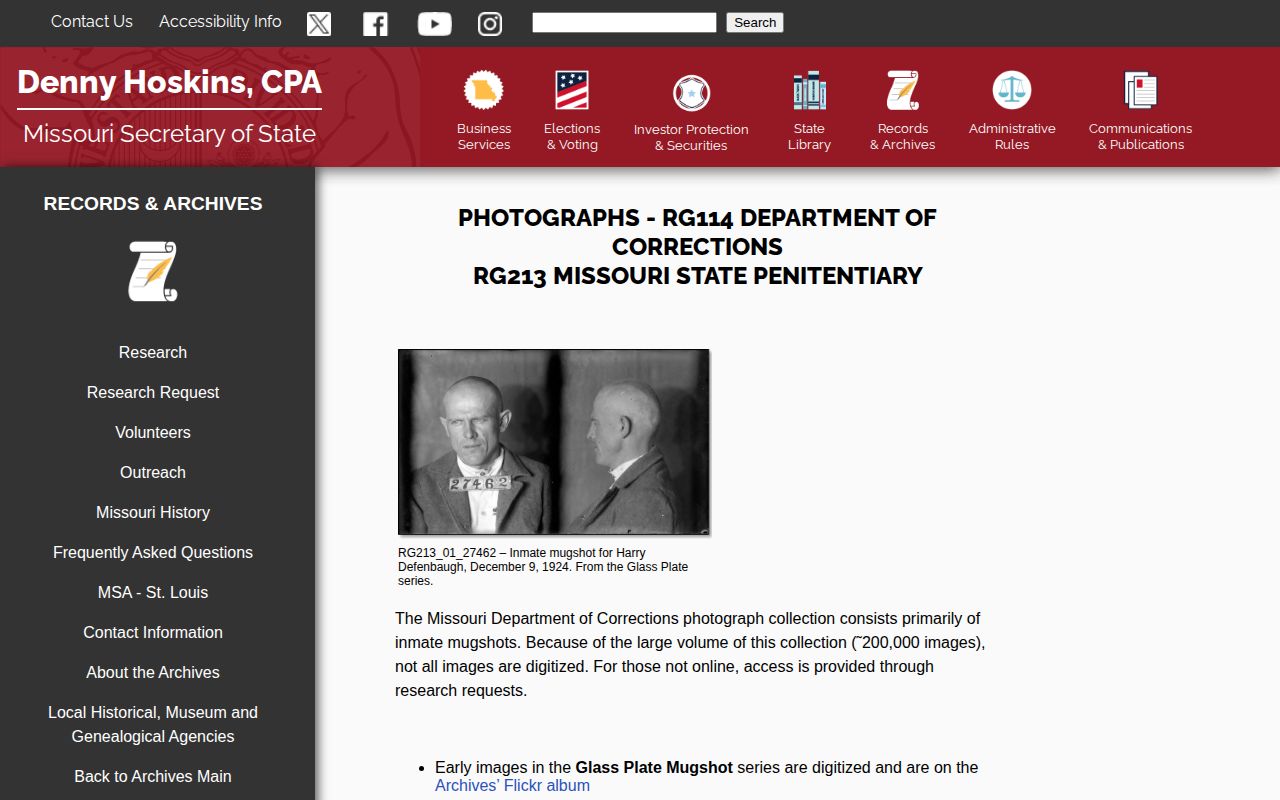
The Archives collection serves history buffs digging into old records, and plenty of its images have never been digitized. Don't count on it for anyone's current arrest status.
For a Patrol record beyond the public web window, MSHP directs requesters to its Public Records Center instructions.
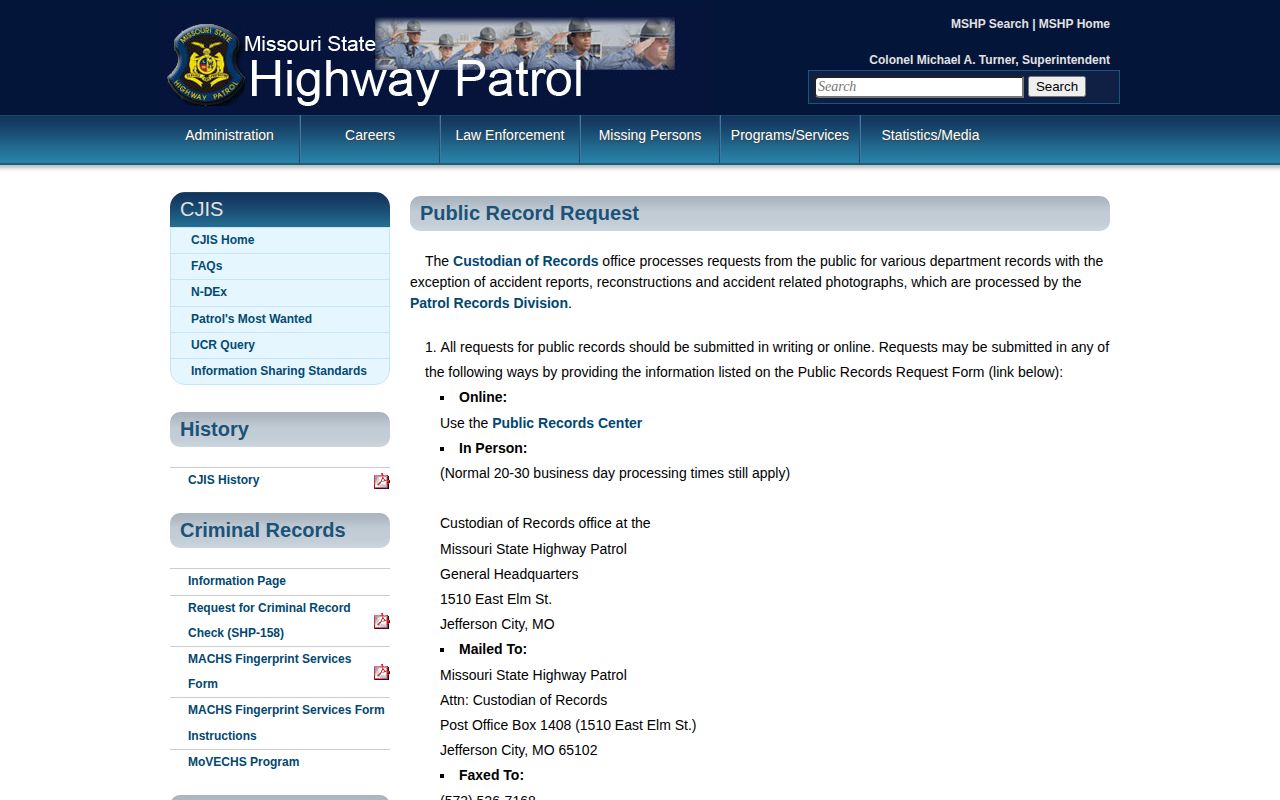
MSHP may take longer on older or complex records. Each county custodian sets its own response times and fees.
The Missouri arrest-report law sets the statutory record categories that govern a request.
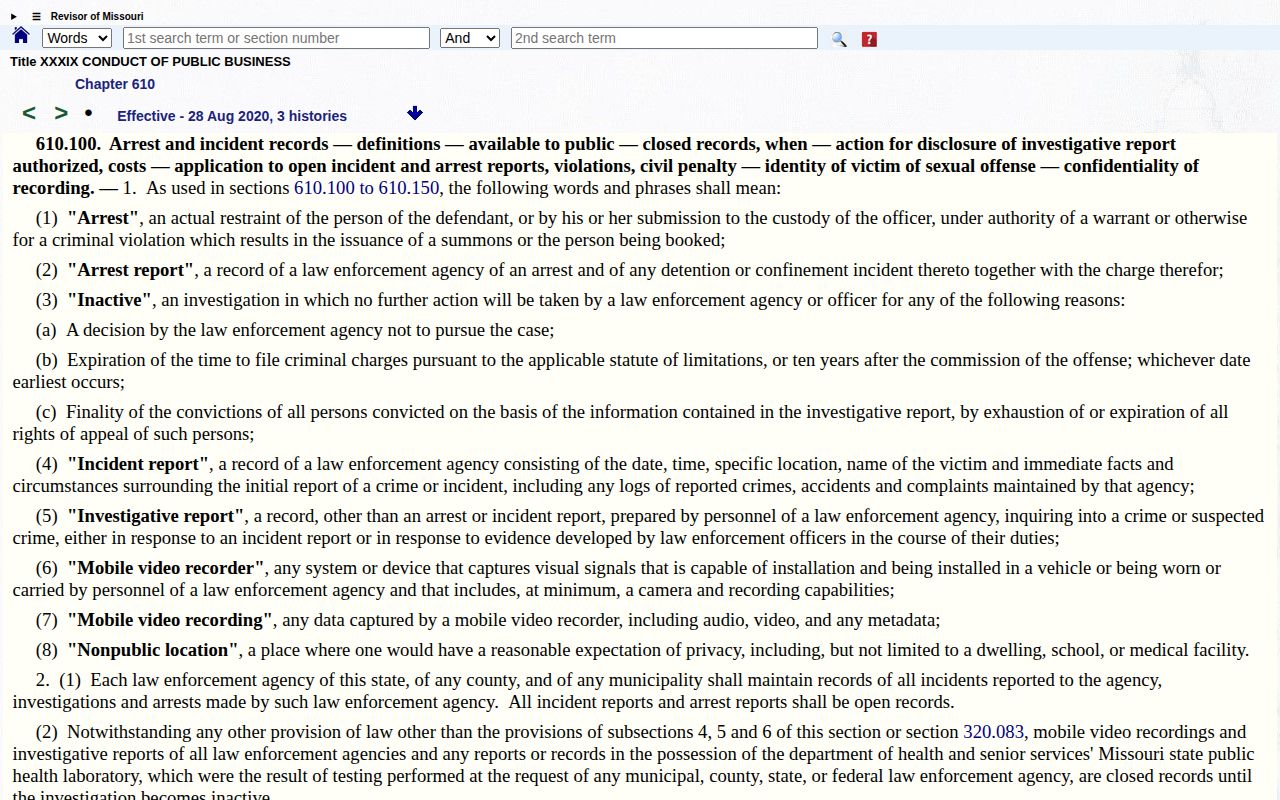
Three things here are separate questions. Ask the custodian directly about the web archive, the record series, and whether a record is public.