
Missouri Arrest Records in Public
Most of the time, yes. Missouri's Sunshine Law leans strongly toward open records. That openness covers most arrest reports, though the type of record and the stage of the case both matter. An agency might publish an online roster, a booking photo page, or nothing at all. Nothing statewide forces counties to run a searchable booking site. Some records also stay closed or partly redacted under a statute, a court order, or an active-investigation rule.
So ask whoever holds the record. The county jail keeps booking and custody data. The arresting police department keeps its own report. The court keeps the docket. A state DOC profile reflects current custody or supervision, not a fresh county arrest. Each of these records can point to the same event, yet none replaces the others.
Missouri Sunshine Law and Arrest Reports
Missouri's Sunshine Law sits in Chapter 610. Under Section 610.011, public records are open unless a specific exemption applies. The law is read strictly in favor of openness. Section 610.100 defines an arrest report as the law-enforcement record of an arrest, detention, or confinement plus the charge. The same statute separates an incident report from an investigative report. The incident report holds basic event facts. The investigative report can hold material that stays closed while an investigation runs. A custodian asked for an arrest report should separate the open portion from what must be withheld. A blank or redacted field does not mean no arrest happened. Timing matters too. What if no charge is filed within 30 days? Then § 610.100 closes the arrest report after that period. Statutory exceptions and the disposition portion still apply. A filed case may end in nolle prosequi, dismissal, acquittal, or a not-guilty result. When that happens, § 610.105 controls closure of official case records while preserving final-disposition data as permitted. Response deadlines come from Section 610.023. A custodian must answer as soon as possible. The deadline is the close of the third business day after a proper request arrives. If more time is genuinely needed, the office should say why and give the earliest expected date. That rule guarantees a reply, not delivery of the record within three days. Fees fall under § 610.026. Paper copies up to 9 by 14 inches are capped at 10 cents per page. Research time may be billed at actual cost. Duplication staff time cannot exceed the average hourly clerical rate. Electronic or audio-visual copies can add copy, staff, and medium charges. Unusual programming work may be billed at actual cost. An estimate and advance payment are allowed. What you pay depends on the format and labor involved, nothing else.
The Missouri Revisor’s § 610.100 text sets the arrest-report definition and important open and closed categories.
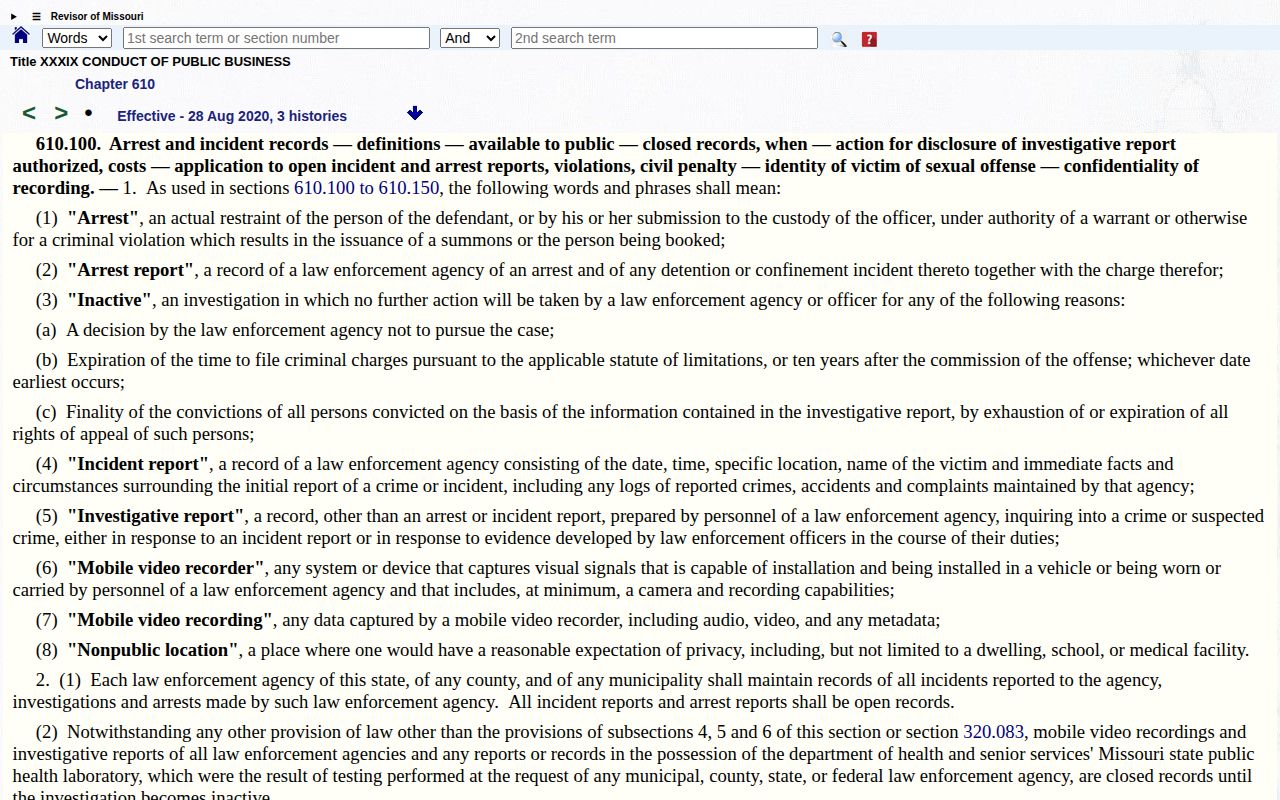
Match the record type to the right law. A jail roster, an investigative file, and a court docket are not the same document, and each is treated differently.
Where Missouri Arrest Records Remain
One empty screen does not end the search. Ask the arresting agency for its report and the booking jail for custody details. Missouri Case.net shows publicly accessible filings and dispositions. The Missouri State Highway Patrol runs its own Online Arrest Reports search. It covers MSHP arrests from the last five days. The DOC Offender Web Search covers people in state custody or supervision now. Each source updates on its own schedule and has its own identity limits.
- Identify the arresting agency and county, then check the official roster or arrest-report page.
- Ask the records custodian for the existing report if the web view is absent or too brief.
- Use Case.net for a public court case and later outcome, not as a live jail search.
- Use DOC only when the question concerns current state custody or supervision.
- For an MSHP arrest, use the Patrol search or its records request route, then confirm booking with the local facility.
See the MSHP arrest page for the Patrol's report and request channels. No Missouri law requires a county to post a booking photo online. The statewide photo landscape separates official sources from secondary indexes.
Missouri County Arrest Record Differences
Missouri counties handle booking information very differently. No statewide roster exists. No law forces a county to post who was arrested in the last day. One sheriff may run a current-inmate list with full booking fields. The next county might offer only a recent-release view or a handful of press releases. Regional vendors sometimes carry historical bookings. Other agencies hand over reports only when you ask. A booking photo shows up on one roster and stays off another.
Those gaps come from agency choices, vendor design, record type, and legal limits. A roster turns over fast. The arrest report behind it sits in a retained record series. Press archives last longer but cover only selected cases. A current DOC image is not a county booking photo. Pick the right source for the record you need. Then confirm with the custodian when a result looks unclear.
Some results stay restricted for good reason. The entry may name a juvenile. It may expose a protected victim, reveal medical details, or hold active investigative material. The law favors access to public portions of a record. It never makes every field public.
Missouri Arrest Record Expungement
Adult expungement in Missouri rests mainly on § 610.140. You petition the court where the charge was filed or the conviction entered. The petition must list every record holder. It must name the courts, police, prosecutors, repositories, and other holders believed to hold the file. Plenty of offenses fall outside the law. Class A felonies lead the list, along with violent, sex, traffic, firearms, and death-related crimes. Eligibility turns on the exact record and the current statute. A general online result cannot settle it.
Timing rules matter too. Many eligible felony records carry a waiting period. The wait is at least three years after an authorized disposition. An eligible misdemeanor, municipal violation, or infraction generally needs one year. The statute adds conditions. Fines and restitution must be paid, supervision or treatment finished, and no charge pending. Limits on later convictions also apply. Meet the conditions on a first qualifying petition and a rebuttable presumption may apply. An arrest may never lead to charge or conviction. That record can support a first arrest-only petition after 18 months, subject to the statute.
- Arrest report
- The law-enforcement record of an arrest, detention, or confinement with the charge.
- Disposition
- The court’s final outcome on a charge or case.
- Nolle prosequi
- A prosecutor’s notice that a charge will not be pursued.
- Expungement
- A court process that closes qualifying records from public access.
| Route | What it changes | Important limit |
|---|---|---|
| Correct a factual error | Ask the source agency or court to fix its record | Submit the exact report and supporting proof |
| Expungement petition | Can close qualifying Missouri records by court order | Eligibility and waiting periods depend on the offense and history |
| Arrest-only petition | May apply when no charge or conviction followed | 18-month timing and statutory conditions apply |
| Publisher correction request | May update or remove a private copy under that publisher’s policy | Does not alter a court or agency file |
| Search-engine refresh | May update an obsolete result after the source changes | Does not seal an official record |
Once an order issues, Section 610.120 governs public closure. § 610.124 handles removal from Missouri electronic files where that is possible. One caution comes from Section 610.126. Expungement never makes the arrest itself invalid after the fact. The court petition form lists agencies that may need notice. For a false arrest record, § 610.122 offers a narrower path with its own conditions.
Missouri is also building automatic screening under § 610.141. It covers some qualifying drug convictions. Offense, timing, and record-history limits apply. The system must be running by January 1, 2027. Do not assume an eligible record has already been closed; check current court and statute information.
The Missouri Courts expungement petition shows the official form and agencies a petitioner may need to identify.
Filling out the form just starts the court process. It is not a ruling on whether a charge qualifies.
Missouri Arrest Record Corrections
A private copy follows the publisher's own correction process. A Missouri court order can close named official records. But it cannot force deletion from an unlisted database, a newspaper archive, a cached page, or a social post. When you ask a publisher to review an item, include the exact URL, the source record, and any signed order or final disposition its policy requires.
Several free routes exist. BustedNewspaper wants a listing URL. It also wants documentation such as a dismissal, nolle prosequi, acquittal, sealing, or expungement. RecentlyBooked takes requests for a wrong person, duplicate, juvenile, restricted, or outdated entry. Mugshots.com says it charges nothing for updates or removals. It wants proof, though, and warns processing can take up to 10 business days with no guarantee. Mugshots.zone uses county-specific forms. It says verification may take up to 10 days. All of these are voluntary private policies, not new legal rights under Missouri law.
| Publisher route | Published free process | Scope |
|---|---|---|
| BustedNewspaper | URL plus supporting court or legal documents; stated window about 5 to 10 days | Its own listing only; Missouri coverage is partial |
| RecentlyBooked | Free correction process for wrong, duplicate, juvenile, sealed, expunged, or outdated items | Its own Missouri state and county index |
| Mugshots.com | Free update or removal route with documentation | Its publisher policy, not an official record order |
| Mugshots.zone county form | Documentation-based form; stated review may take up to 10 days | County subdomain copy only |
The RecentlyBooked correction policy sets out its own free request path for records on that private service.
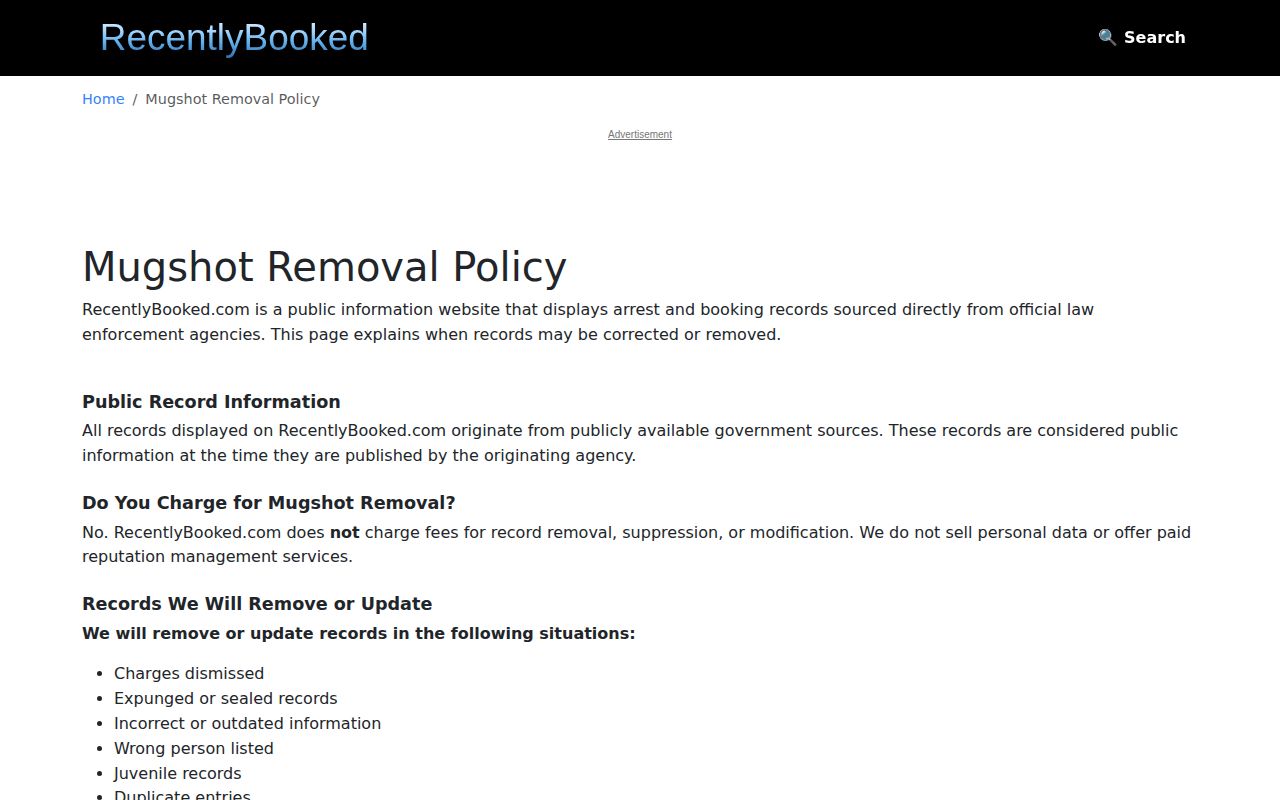
A request to this publisher changes only its own copy and never amends the original government record.
The Mugshots.com record-maintenance page describes its separate free update and removal grounds.
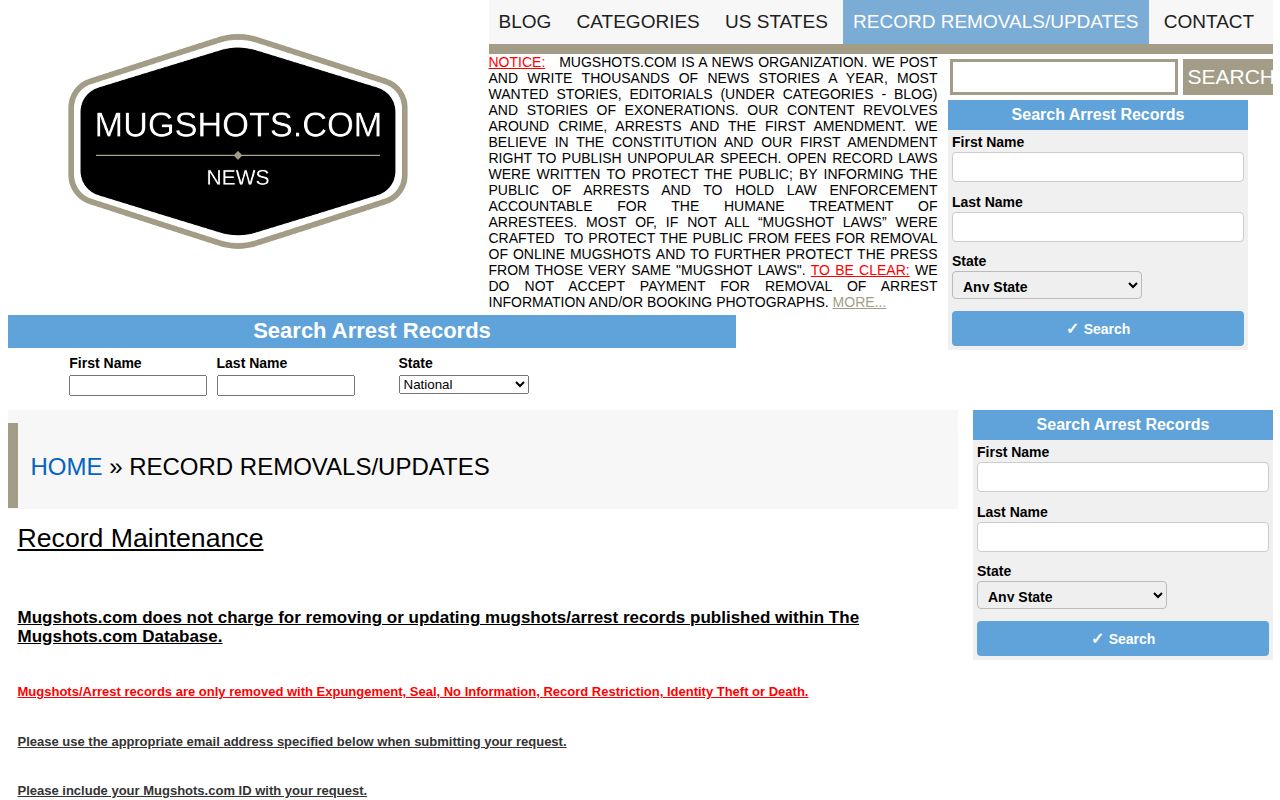
Watch the policy's scope and response terms. A private form is not a court order or agency correction.
Missouri Arrest Records and Archives
A public search page and the government record series behind it age at different speeds. Under the Missouri Secretary of State's sheriff schedule, arrest records carry a five-year minimum retention period. Booking sheets are included. Jail activity logs and inmate files appear on the schedule separately. Fingerprints, photographs, and other biometrics normally go to the MSHP Central Repository. A sheriff may keep a reference copy. A minimum schedule does not promise that every item stays open or available online.
The State Archives preserves material with lasting historical value. Its RG114 Corrections photographs collection holds roughly 200,000 historical inmate mugshots. Many were never digitized. The collection serves no current booking or custody lookup. For an older Missouri arrest record, ask the creating agency first whether the record series still exists. Then follow its retention or archival referral. Closure rules and expungement orders keep applying to records held by government.
Missouri’s Arrest Photo Payment Ban
Missouri built its mugshot-payment ban around one statute. Section 407.1150 defines a booking photograph as one taken by a Missouri arresting agency. It folds the photo together with the arrested person's name, address, charges, and a description of the alleged conduct. A publisher cannot ask that person for money. Nor can it demand anything else of value in exchange for removing or correcting the covered information. Break the rule knowingly and willfully, and it is a Class A misdemeanor. Each payment counts as a separate violation.
The civil side carries real teeth. A wronged subject can recover $10,000 or actual and punitive damages, whichever is greater. Attorney fees and court costs come on top. Humiliation or embarrassment alone can establish harm, with no physical injury required. Lawmakers passed the statute in 2014. It answered demands that people pay to see their booking photo taken down. Earlier drafts floated firmer correction deadlines, but those proposals never became law. The statute does not outlaw booking photos themselves. It also does not erase an arrest record after a dismissal.
Never pay a middleman who promises to make a public record vanish. Fix an error at the official source first. If the record might qualify for closure, use a court process. A publisher's own free correction route, where one exists, is the last step. An agency order does not automatically reach a private copy. A removal request should not imply that it does.
The official Missouri § 407.1150 text contains the definitions, prohibition, misdemeanor, and civil remedy.
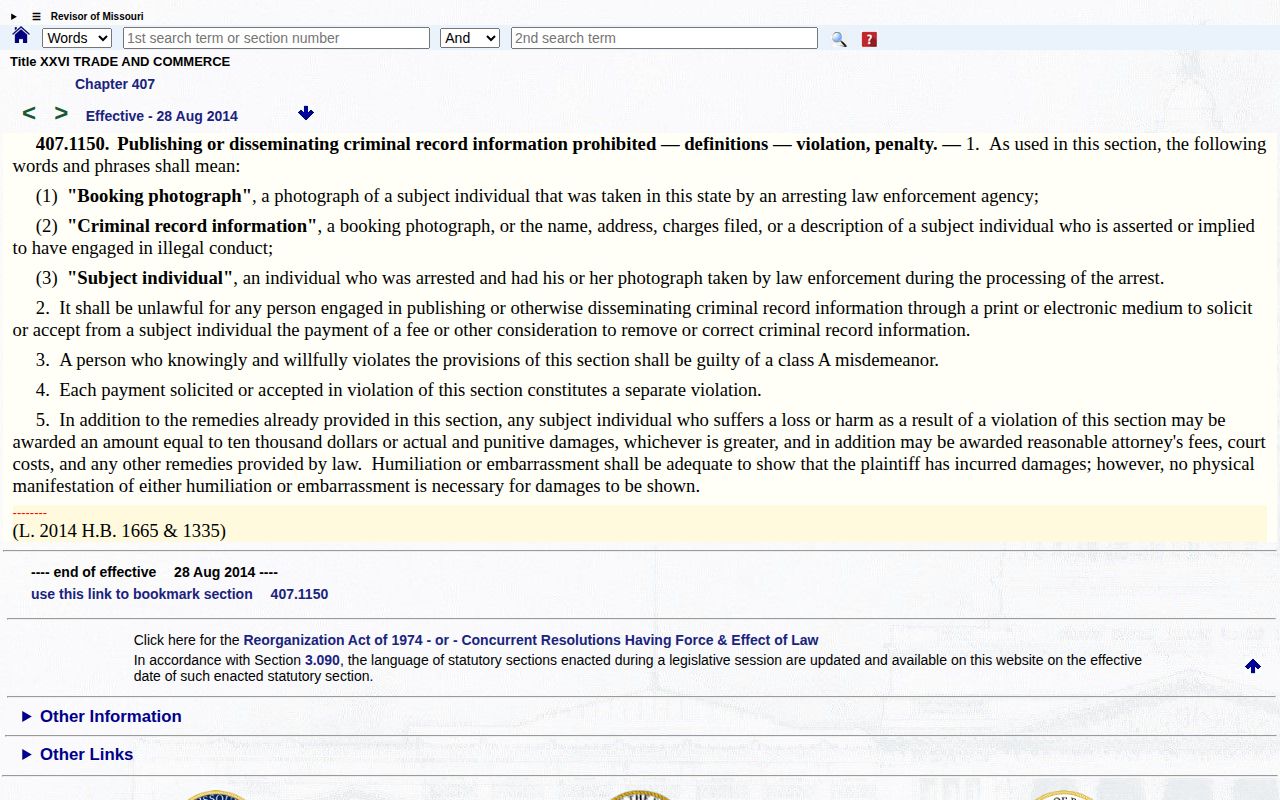
The statute limits payment demands tied to removal or correction. It does not promise that every correct private copy gets deleted.