
How Missouri Arrests Appear
Missouri has no shared booking system for all 115 county and city jurisdictions. Each sheriff or jail operator picks its own format. Some publish a current roster, others a short release list or searchable feed. Some post nothing at all. A live roster may cover only people still in custody. A press post names a few arrests. It skips the rest. Someone held briefly and released may never show up anywhere.
Start with the arrest county. Open its locality link in the Missouri County Directory. Then go straight to the official sheriff, jail, or police source. The statewide examples show how labels differ. Barry County's sheriff keeps a current roster. It also posts a separate release view. The DeKalb and Daviess regional JailTracker portal serves two counties at once. Neither sets a rule for Missouri. A roster can list charges and bond yet omit the booking photo or past arrests.
| Official source pattern | What it can show | Scope to keep in mind |
|---|---|---|
| County or regional current roster | Name, booking or custody status, charge, bond, and sometimes a photo | Coverage, history, and photo policy vary by system |
| Short-window release view | Recent people released, with a named period where stated | Barry’s page is a 48-hour view, not a 24-hour statewide feed |
| MSHP Online Arrest Reports | Searchable Missouri State Highway Patrol arrests | Preliminary Patrol data, automatically posted for five days |
| Agency press or social posts | Selected arrest news or event summaries | Not a complete roster and may be edited or removed |
| Records custodian | Existing arrest reports or booking records after a request | Ask the agency that made or holds the record |
Note: A missing online entry may reflect delay, release, source limits, or no public feed, rather than the absence of an arrest.
Route Arrests by County
County pages are the route into local systems, not one shared feed. Larger and regional systems may offer a vendor search with booking detail. Smaller counties lean on a sheriff's press page or a records request. Some rosters track current custody only. Others keep prior bookings for a limited stretch. A county seat helps you name the right locality, but it does not prove where a person was booked.
For a city arrest, city police may hold the arrest report even when booking happened at a county or regional jail. The arresting agency and the booking facility can differ. Use the locality site to find the local agency. Then confirm the record with that custodian. MSHP arrests are county-routed too. A Patrol report names an arrest county and troop, but it does not promise a matching photo on the county roster.
Find Someone Arrested Today
A fresh booking may take time to reach a public screen. Missouri sets access rules for records. State law sets no statewide posting deadline. When a county source states its own time window, trust its label. "Current inmates," "released in 48 hours," and "arrests today" describe different views. A publication date never equals an arrest time.
- Use the county or city where the arrest is believed to have occurred, then open that locality in the directory.
- Check the official roster, booking search, or recent-release page. Read its date range and photo notice before relying on it.
- If the person is not listed, call or write to the sheriff, jail, or arresting police agency. Ask whether a record exists and which unit keeps it.
- For a specific person’s custody changes, use Missouri’s MOVANS custody alerts. A no-result screen does not rule out custody.
The statewide same-day page, Daily Arrest Report, maps the source types and helps you choose the right window. MSHP arrests get their own tool. The Patrol's official reports page runs a separate five-day search.
Where Missouri Arrest News Appears
Official channels answer different questions. A roster shows the jail view. A police report records the arrest. A court docket tracks the case. The Missouri Case.net portal displays public filings and dispositions, yet it is neither a live booking feed nor a full warrant list. A name match alone proves nothing about identity.
| Channel | Official? | Use and limit |
|---|---|---|
| County sheriff, jail, or local police | Yes | Current booking, release, arrest report, or request route; coverage varies |
| MSHP Online Arrest Reports | Yes | Preliminary Patrol arrests, five-day online window |
| Missouri Case.net | Yes | Public case events and dispositions, not current custody |
| Missouri DOC Offender Web Search | Yes | Current state custody or supervision, not a fresh county booking |
| Local and statewide news | Editorial | Selected stories; a report or photo may be omitted or later updated |
| Commercial arrest indexes | No | Secondary copies may lag, omit context, or match the wrong person |
For an arrest log spanning several days, the Weekly Arrest Log page separates county blotters, Patrol releases, and news archives. To confirm a name, date, or outcome, go back to the official source.
What a Missouri Booking Record Shows
A booking record starts when a person is processed after arrest. It can hold personal identifiers and the agency's first charge entry. The roster may show only part of it. Fields differ by county and vendor. Never fill a blank field by guesswork. These rows describe common Missouri distinctions, not a promise that every county page carries each item.
| Record field or layer | What it means |
|---|---|
| Name, age, or booking number | Identity fields held by the booking source; check more than one field where available |
| Booking date and time | Intake timing as recorded by the jail, which may differ from arrest or post time |
| Arresting agency and county | Who made the arrest and where the case was routed; not always the booking facility |
| Charge and bond | Charge recorded at intake and any bond amount shown; charges can change |
| Custody status and location | Whether the source currently marks a person held, released, or moved |
| Booking photo | An agency image when the source displays one; Missouri has no universal photo-posting rule |
| DOC offender profile | State custody or supervision details and an identification photo when available |
| Case.net docket | Court events, filings, and public disposition information, not booking status |
Missouri law defines an arrest report as a law-enforcement record of an arrest, detention, or confinement plus the charge. It is not an incident report. It is not an investigative file either. A roster is just one display layer, so a record request may reach an existing report long after the roster rolls forward.
Missouri Mugshots and Booking Photos
Missouri counties handle booking photos their own way. Some rosters attach a booking image to each active record. Others show only a name and charges. A few maintain a current-inmate list with no photo at all. Some make you ask the records custodian directly. Nothing in statewide rule forces every sheriff or jail to post photos online. There is one more wrinkle. An image on a state DOC profile is an identification photo tied to state supervision. It is not the county booking photo from the arrest.
Private indexes cover only part of the state, so treat them with care. BustedNewspaper’s Missouri section, RecentlyBooked, Mugshots.com, Arrests.org, and county subdomains on Mugshots.zone are not official rosters. Their entries can be delayed, incomplete, duplicated, or simply out of date. They never replace the booking agency’s own record. Local newsrooms such as KSHB 41 also make their own editorial choices. They decide when a booking photo runs.
For a documented state-custody image, start with the Missouri DOC Offender Web Search. It displays an identification photo when one exists. It leaves out people who have been discharged. It also does not convert a prison intake photo into a county booking photo. Always work from the source screen when confirming a record.
Missouri has a narrow statute. It targets demands for payment to remove or correct covered information. It promises no removal of every accurate image. For the legal details and free correction routes, see the Public Arrest Records law page.
The official DOC offender search explains the state-custody profile that is distinct from a county booking image.
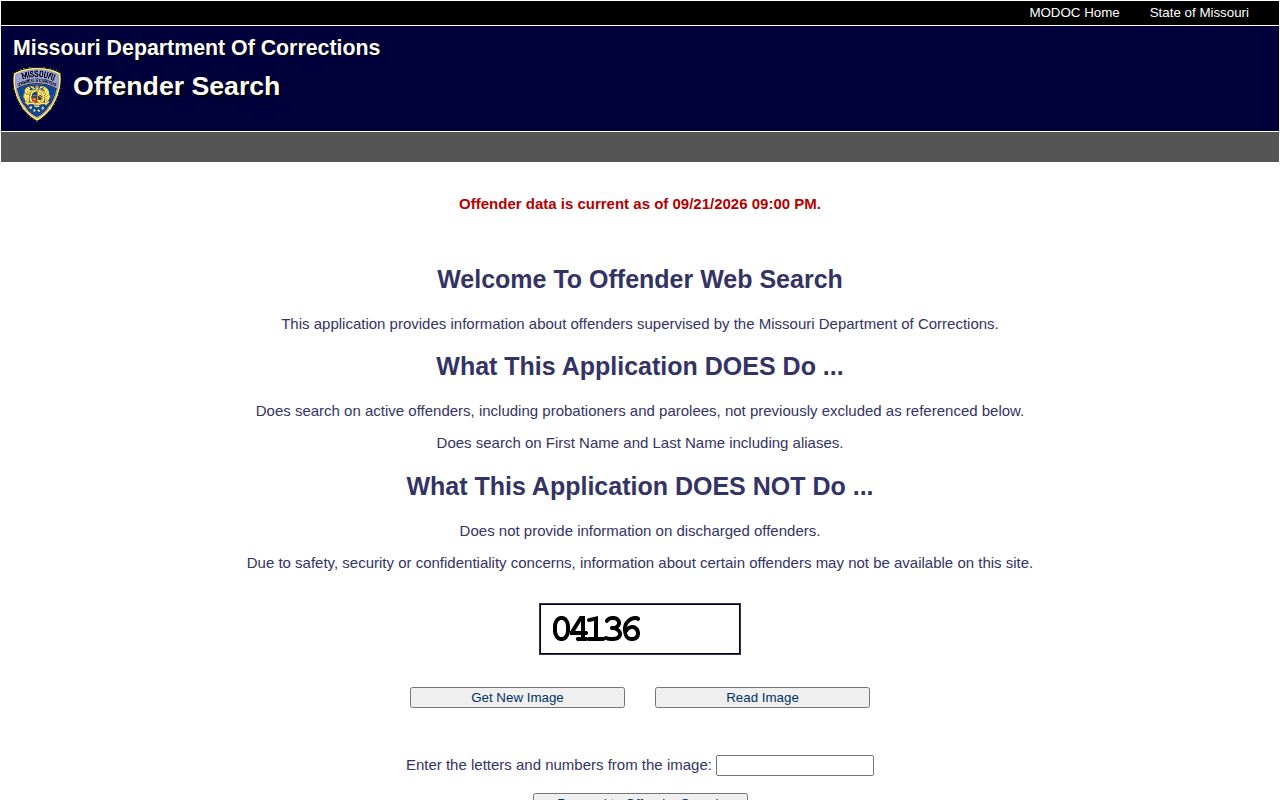
Save this profile for questions about current DOC custody or supervision. A recent county arrest belongs with the booking agency that holds it.
Missouri Secondary Photo Indexes
Private arrest indexes copy from official sources. They are not custodians, and they skip plenty of counties. BustedNewspaper lists only some Missouri localities. RecentlyBooked, Mugshots.com, and Arrests.org run secondary pages. County subdomains on Mugshots.zone do too. Entries can be delayed, duplicated, incomplete, or attached to the wrong person. Before trusting a copied entry, check the official county roster or ask the arresting agency.
Each publisher sets its own correction path. BustedNewspaper’s free request needs the page URL. It also needs proof such as a dismissal, acquittal, or expungement. RecentlyBooked describes a free process for a wrong person, duplicate, juvenile, sealed, or outdated record. Mugshots.com charges nothing for an update or removal. It wants supporting documents, and it offers no timeline. Mugshots.zone uses county-specific forms. Arrests.org posts no clear free opt-out, so make no assumptions about one. None of these policies closes a Missouri court or agency record.
The RecentlyBooked correction policy describes its free route for errors and restricted records.
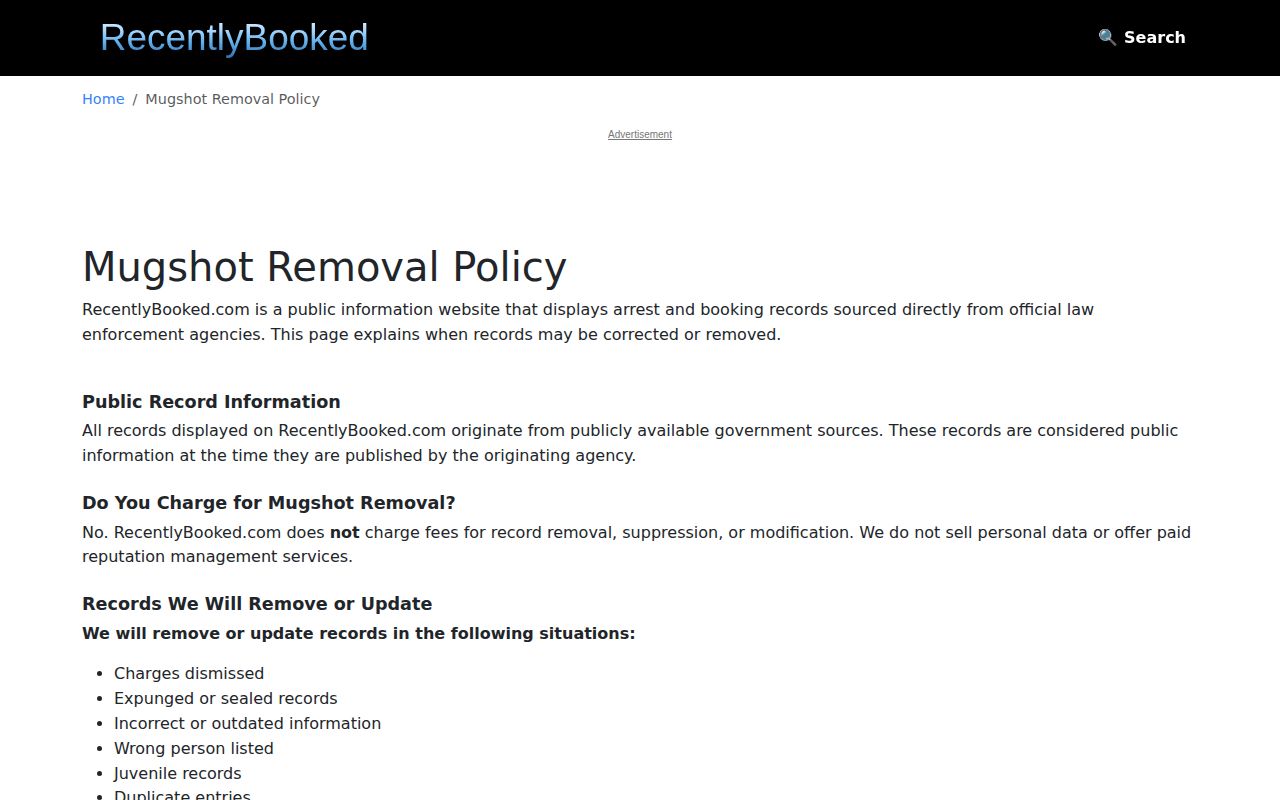
Apply a publisher’s policy only to that publisher’s own copy. The official source remains the record that counts.
The Mugshots.com Missouri index shows a private state and county navigation structure.
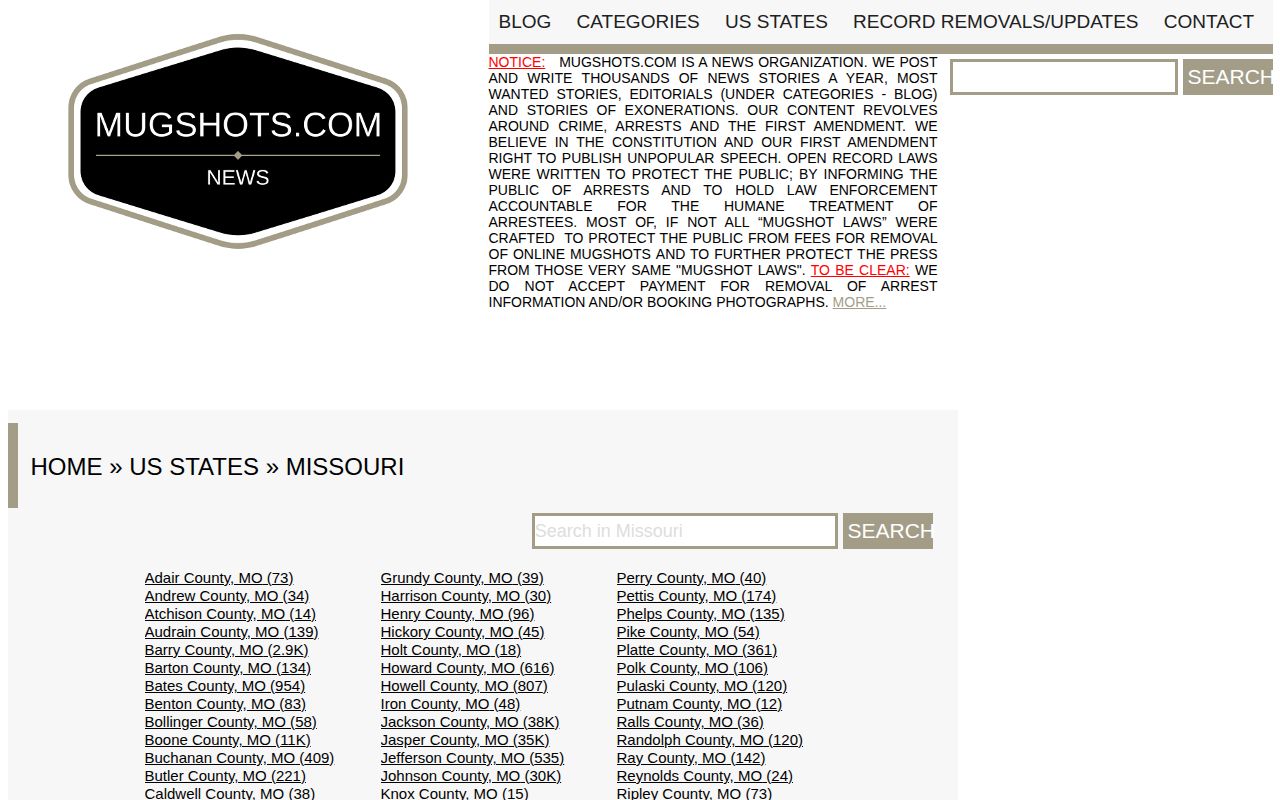
A landing page proves neither full coverage nor current custody. Take the county agency route instead.
The Mugshots.com record-maintenance policy lists its own free update and removal grounds.
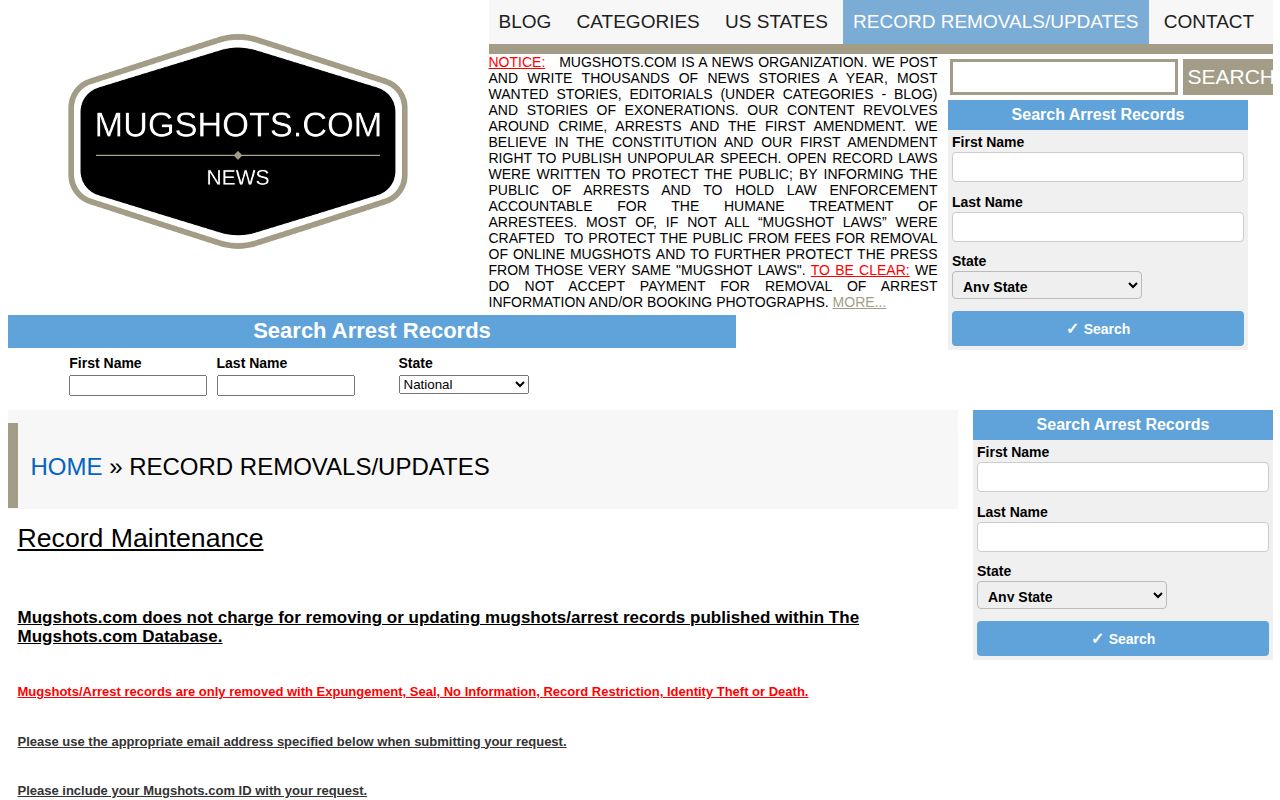
That private procedure demands proof, and it cannot replace an order directed to a Missouri agency.
The RecentlyBooked Missouri landing page shows a secondary index that gathers county entries.
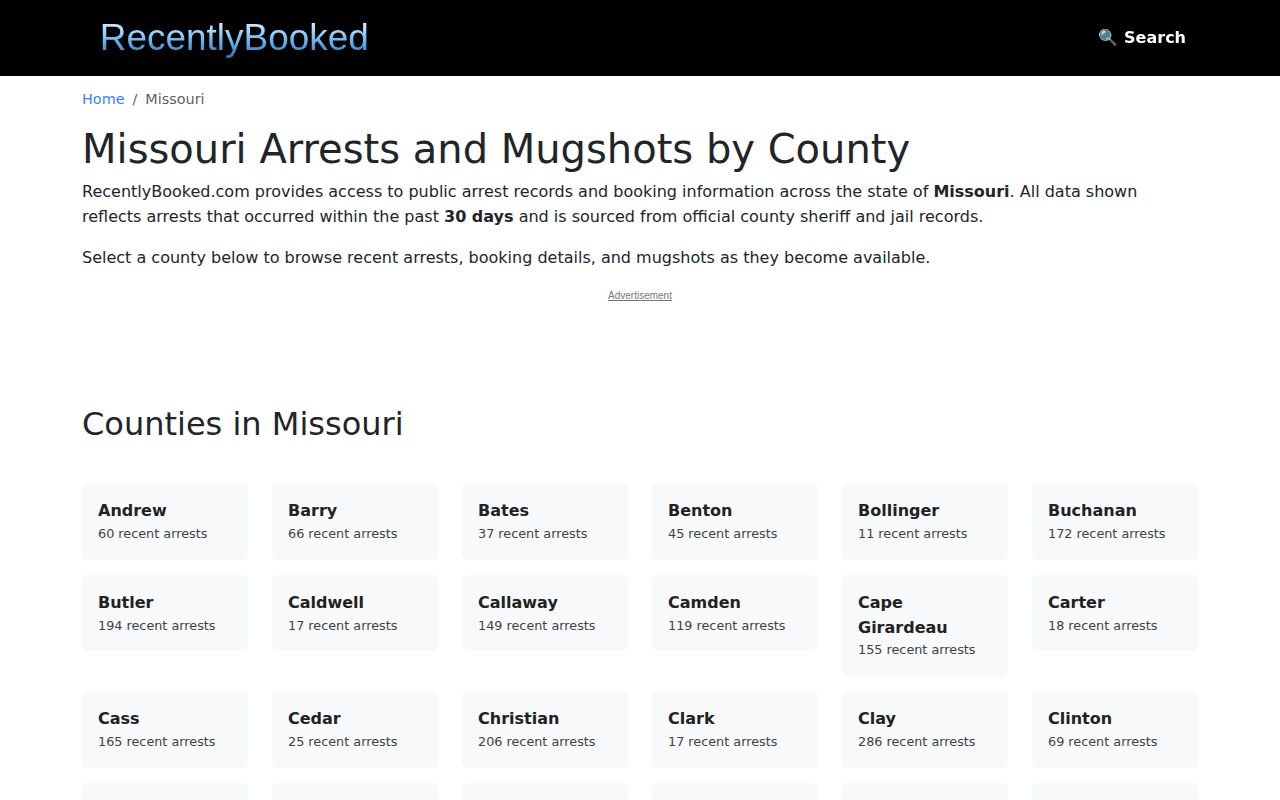
Read the current disclaimer and correction rules first. KSHB 41 Kansas City takes a narrower newsroom line. It generally limits police mugshot use and offers an appeal route for an existing image. Other outlets may fix a factual error. Or they may note a later case outcome while keeping the story archived. A good correction request includes the exact story URL, the case number, and the official disposition. Never pay an intermediary to make a public record vanish.
Request a Missouri Arrest Record
A feed may come up empty. Go straight to the agency that created or keeps the report. Name the record, the date range, the county, the arresting agency, and your preferred format. The Missouri Sunshine Law tells custodians to respond as soon as possible. Generally that means no later than the end of the third business day. A reasonable delay can be explained instead. Response duties do not open every field. And they do not require a photo to be posted online.
- For a county booking sheet or arrest report, identify the sheriff, jail, city police, or regional jail custodian from the locality’s official page.
- Describe the existing record with a known name, event date or range, arresting agency, and record type. Ask for an estimate before work begins.
- For an MSHP report, use its Public Records Center or the Patrol’s written request channels, and state the troop, county, date, and record type.
- For court entries, use Case.net or the circuit clerk. For state custody, use DOC’s search or Sunshine contact rather than the county jail.
Fees are capped under § 610.026. Paper copies no larger than 9 by 14 inches cost at most 10 cents per page. Research time runs at actual cost. Duplication staff time is capped at the average clerical hourly rate. Electronic or audio-visual copies can add copy, staff, and medium charges. Unusual programming may also be billed at actual cost. Ask for an estimate before production begins. MSHP warns that some Patrol requests run slow. Archived, older, active, or complex records can take about 20 to 30 business days. That window applies to Patrol requests, not to every Missouri custodian.
Sheriff retention schedules set a five-year minimum. That floor covers arrest records and booking sheets. A public website may still drop a listing far sooner. When a record ages off the roster, request it by date and series. The state law page walks through closure, expungement, and correction options.
History researchers have a separate trove. The Missouri State Archives holds a corrections photograph collection of roughly 200,000 inmate mugshots. Many are not digitized. Its RG114 research page describes the collection. That collection is not a current-arrest search. A statewide record can outlive any web roster. But age, retention, archival value, closure, and digitization each raise their own questions.
Missouri Arrest Record Law
Missouri opens its records by default. The Sunshine Law sets that baseline, then carves out narrow exemptions. Under Section 610.100, an arrest report is the record an agency keeps of an arrest, detention, or confinement, plus the charge. Incident reports and investigative reports are distinct categories. An active investigation can hold closed material. Even so, the agency must weigh whether part of the file can be released in the open. Keep two things straight. A booking roster is not the full arrest report. And an open record does not have to appear as a searchable web page.
Missouri also has an anti-pay-to-remove law. Section 407.1150, passed in 2014, covers booking photos and certain criminal-record information. It forbids a publisher from soliciting or accepting money or other consideration from the subject to remove or correct that material. A knowing, willful violation is a Class A misdemeanor. The civil remedy runs to $10,000 or actual and punitive damages, whichever is greater, plus fees and costs. The law is narrow. It regulates payment, not publication, and creates no general right to erase an accurate record.
The official § 610.100 text shows the arrest-report definition and public-record categories.
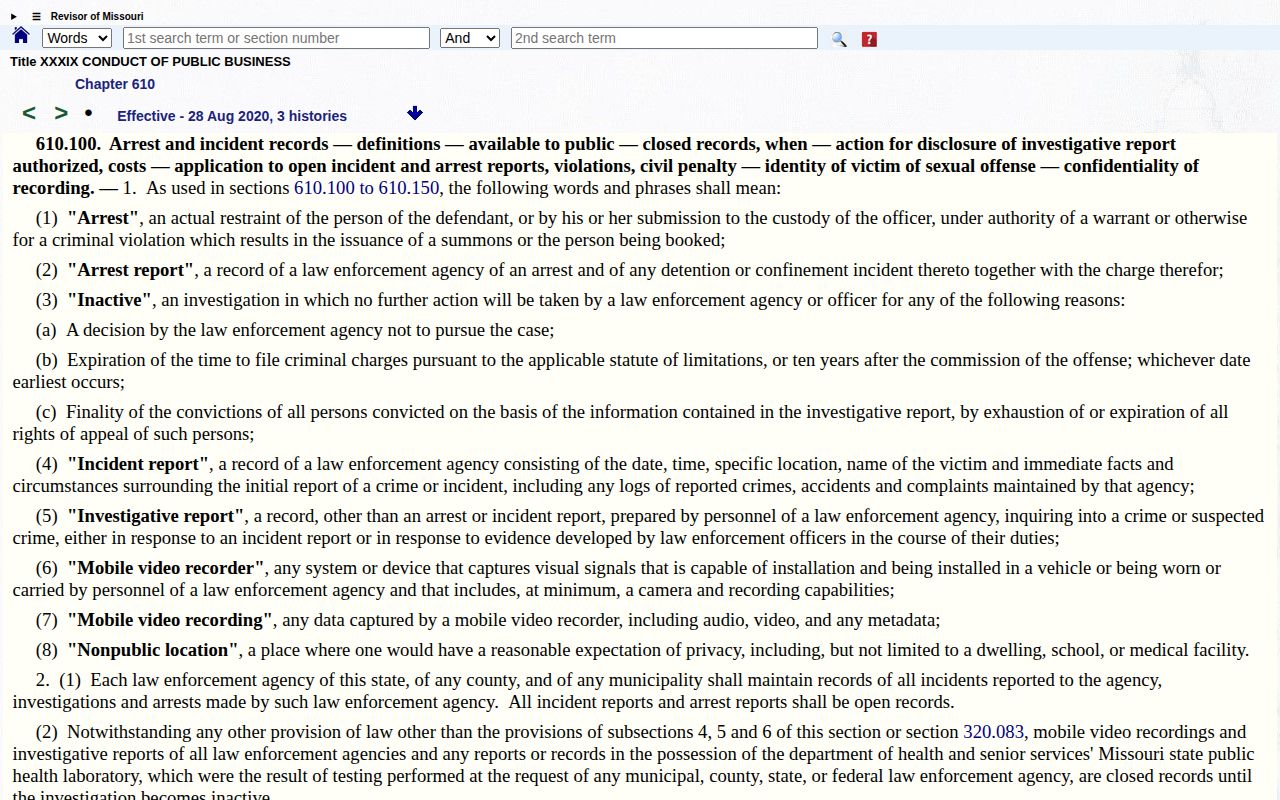
Read the statute's 30-day no-charge rule and its exceptions alongside the rest of Chapter 610, including the final-disposition section.
The official § 407.1150 text defines covered booking information and the ban on paid removal demands.
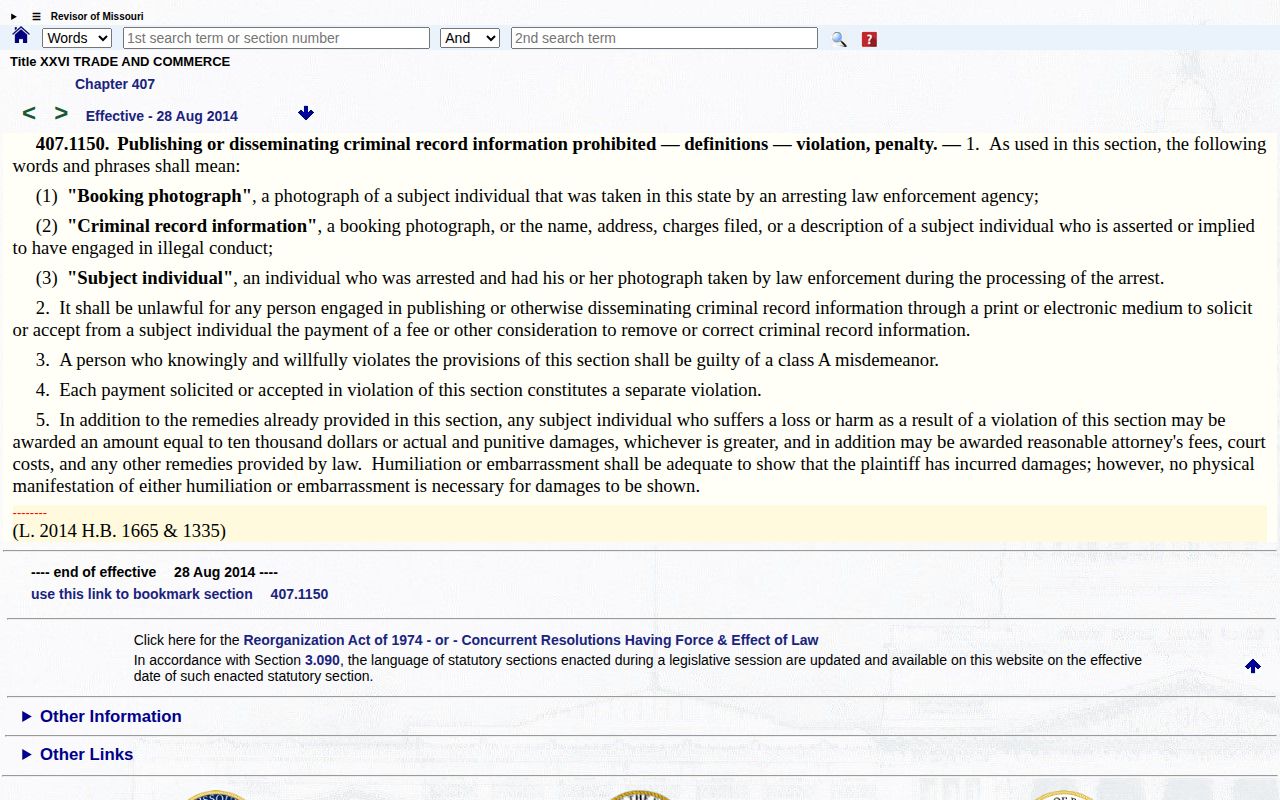
A dismissal does not erase a booking photo. Even when a case ends well, the mugshot can stay put. A favorable outcome can back a correction request, though. An eligible expungement order works differently: it closes the government records it names. Private publishers play by their own rules. A news archive or search cache may need a separate update under its own policy, and the enacted text does not force anyone to remove an accurate item for free.
Juvenile protections are stronger still. Under § 211.321, juvenile court records and many juvenile law-enforcement records stay closed, with limited statutory exceptions. Agencies also hold back victim details, medical information, protected identifiers, and active investigative material. The Public Arrest Records law page gives the full statewide treatment of open records, sealing, expungement, and correction.
Missouri Warrants and Wanted Lists
Missouri has no single public page that confirms every local warrant. Each warrant comes from a court. The issuing court and its law-enforcement agency keep the current status. A public wanted notice can flag an active request for help, yet lists lag once a warrant is served, recalled, or changed. Treat any list as a lead to verify.
Several official sources cover pieces of the picture. The MSHP site map links Patrol's Most Wanted notices. The Missouri Sex Offender Registry has its own absconder category, which is not a general arrest or warrant roster. DOC's Probation and Parole division covers supervision and absconder work. The U.S. Marshals Service posts profiled fugitives for the Eastern District and the Western District of Missouri. Local warrants still require county sheriff and court sources. Case.net shows public case events, but it is not a complete warrant database.
Worried about a warrant in your own name? Contact the issuing court or agency, or talk with a lawyer. If a notice names someone else, never approach or follow that person. Send a tip to the listed law-enforcement contact instead. Call 911 for immediate danger. A copied photo or third-party list is never a reliable test of whether a warrant is current.
The MSHP official site map links its Patrol’s Most Wanted material and other distinct arrest tools.
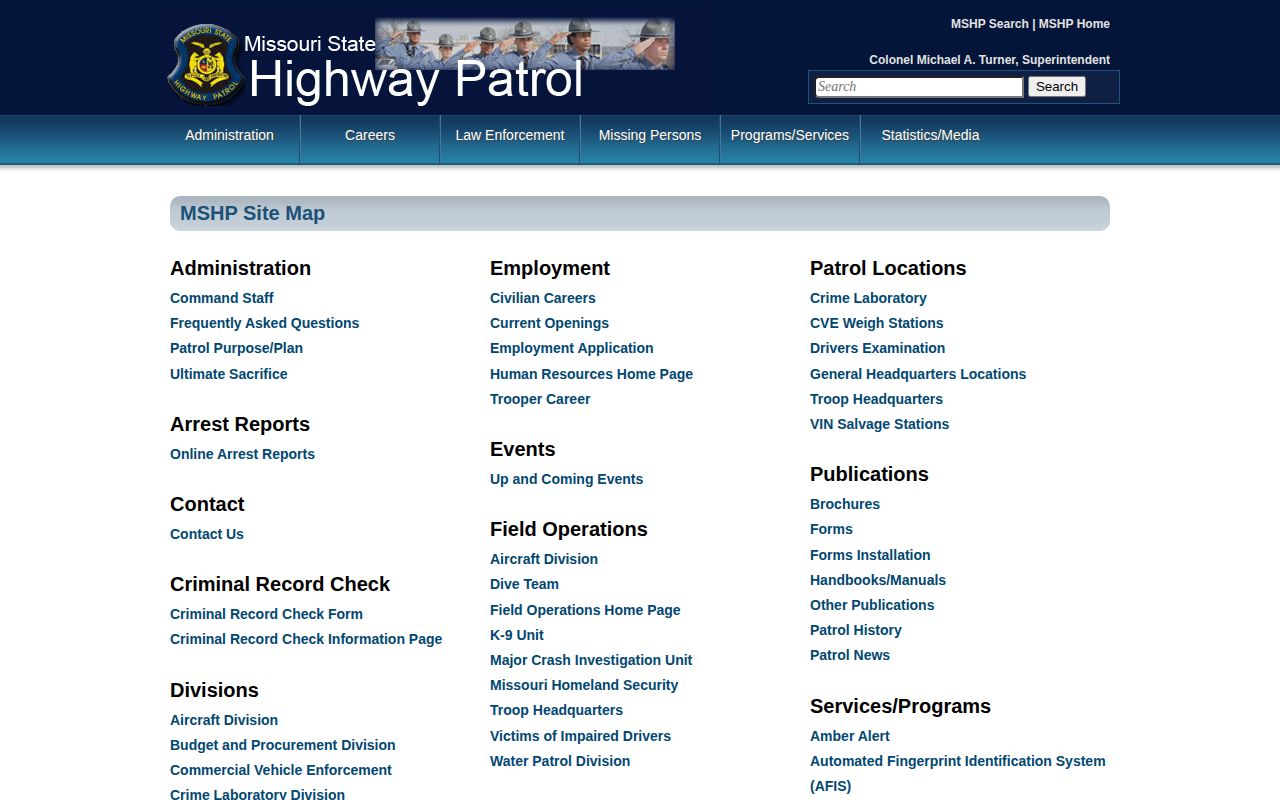
This page is an agency notice, not a statewide warrant search. Contact the listed agency to confirm a warrant's status.
After Arrest: Court and Custody Records
An arrest record opens one part of a case. The court docket takes over from there. It later records hearings, amended charges, plea or trial results, and sentence details. A disposition is simply the court's final outcome on a charge. Nolle prosequi means the prosecutor dropped pursuit, and a dismissal or acquittal changes the record the same way. A booking entry by itself shows none of that.
| Record source | Question it answers |
|---|---|
| County jail roster | Is this person shown in the facility’s current custody system? |
| Arrest report | Which agency recorded the arrest, detention, or confinement? |
| Missouri Case.net | What public court filings, hearings, or disposition appear? |
| DOC Offender Web Search | Is the person in current state custody or supervision? |
| Federal Bureau of Prisons locator | Is the person in federal custody? The locator provides no booking photos. |
| ICE detainee locator | Is a person currently in ICE custody or covered recent CBP custody? |
The DOC offender search leaves out discharged people and some protected records. For federal custody, the BOP locator reaches back to 1982. It shows no photos. A release result will not say where a person went. The ICE locator demands exact identifying fields, skips anyone under 18, and covers only its stated custody scope; none of these is a Missouri county booking feed.
The Bureau of Prisons locator is a custody search with identifying fields, not a booking-photo source.
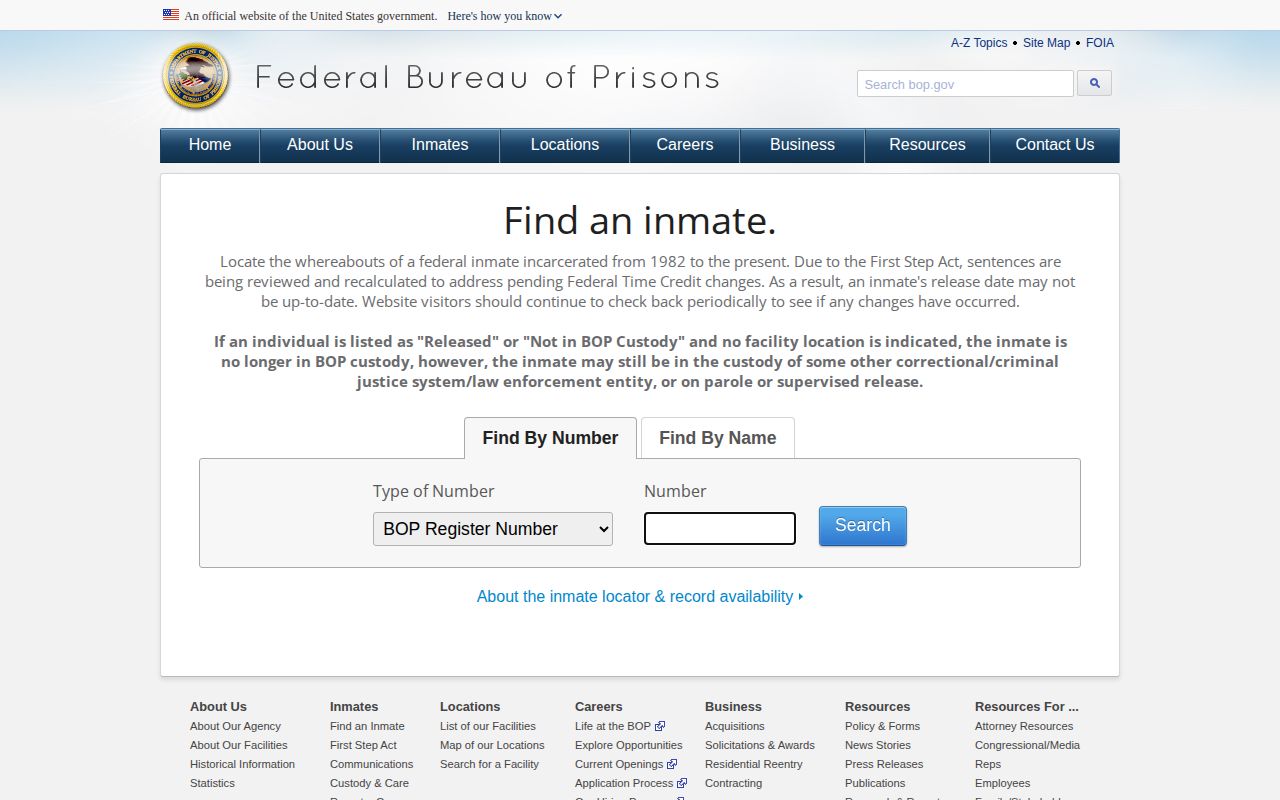
The federal BOP locator skips booking photos entirely. It works for locating someone in federal custody, but it says nothing about a Missouri arrest and nothing about where a person went after release.
Booking, arraignment, bond, and expungement are four different stages. Each one means something distinct. Booking records the arrested person's identity, the charges, and custody details at intake. Arraignment is an early court appearance. Bond sets the conditions a judge imposes for release. Expungement is a court process that closes qualifying records from public view, though it does not erase the arrest itself.